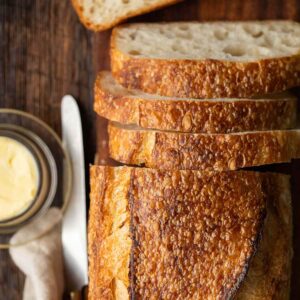
Sourdough Sandwich Bread Recipe
This straightforward recipe yields a gorgeous loaf of sourdough sandwich bread that's golden outside and chewy inside. Plus tips if you want to make a soft sandwich loaf!
Servings: 16 servings
Calories: 120kcal
Email This Recipe
Get this recipe link emailed straight to your inbox!
Ingredients
To Feed Your Starter:
- 60 grams sourdough starter
- 60 grams unbleached all-purpose flour
- 60 grams non-chlorinated water
Dough:
- 125 grams ripe sourdough starter, once it’s active and bubbly, weigh 125 grams of the fed starter
- 350 grams non-chlorinated water
- 12 grams sea salt
- 500 grams bread flour
Instructions
Feed Your Starter (4 to 12 hours wait time)
- Feed your starter so that it’s at peak when you’re planning to make the dough. Around 4 to 12 hours before you want to make the dough is the general timeframe, but you know how long it takes your starter to reach peak after a feeding, so go with that. To feed your starter, mix all ingredients together in a clean jar. Cover loosely and let it rest at room temperature until it peaks. This usually takes about 4 to 12 hours; I like to do this the night before I want to make the dough, right before I go to bed.
Make the Dough (30 minutes wait time)
- Add the active starter, water, and salt to a large bowl or container (glass or clear so you can see through the sides and bottom) and whisk to combine (it doesn't have to be fully integrated, but it should look milky). Add the flour and stir to form a shaggy dough (don’t knead it; some dry spots are fine).
- Cover the container and let it sit at room temperature for 30 minutes.
Perform the Stretch and Folds (90 minutes wait time)
- Wet your hands and perform your first set of stretch and folds. To do so, grab a piece of dough, gently stretch it up, fold it over, and then rotate the bowl 1/4 turn. Repeat this process 3 more times until you come to the point where you started. Cover the bowl and let the dough rest at room temperature for 30 minutes.
- After 30 minutes, repeat the stretch and fold process. Cover the bowl and let the dough rest at room temperature for another 30 minutes. Repeat this process 2 more times, for a total of 4 sets of stretch and folds spaced 30 minutes apart.
First Rise/Complete Bulk Fermentation (4 to 8 hours wait time)
- After the 4th set of stretch and folds, cover the bowl and let the dough rest at room temperature until puffed (it doesn't have to be doubled in size; 50-75% rise is normal for this recipe), the top of the dough is slightly domed and bubbly, and the bottom looks spongy. At 74F room temperature, for me this usually takes around 6 to 7 hours, but it can anywhere from 4 to 8 hours depending on your conditions (such as how active your starter is, your kitchen’s temperature and humidity, etc.).
Shape
- Butter the inside of a 9 by 5-inch loaf pan.
- Lightly spritz your countertop with a little non-chlorinated water and wet your hands (I prefer to roll out my dough with water instead of flour). Scrape your dough out onto the dampened countertop and roughly shape it into a rectangle about 13 to 14 inches long by 8 to 9 inches wide (it doesn’t have to be perfect). Gently press the dough with your fingertips to get rid of excess gas bubbles. Fold your dough in thirds like a letter, then starting with one end, roll up the dough into a log. To get some surface tension, cup the dough with your hands and gently pull it towards you across the countertop a few times.
- Place the dough (seam side down) into the prepared loaf pan. Cover the pan with plastic wrap.
Second Rise/Proof (1 to 4 hours at room temperature or 12 to 24 hours in the fridge wait time)
- Let the dough rest until it’s properly proofed, about 12 to 24 hours in the fridge or 1 to 4 hours at room temperature. You’ll know it’s properly proofed when it looks puffed (however, it won't be doubled in size) and jiggles when you gently shake the pan. Also, the poke test is helpful as a guideline; lightly flour your finger and the dough’s surface, and gently press your finger into the dough. If it springs back slowly (instead of springing back quickly or not at all), it’s ready to bake. You can let it proof at room temperature or cold proof in the fridge.
Preheat, Score, and Bake (20 minutes wait time)
- Preheat the oven to 450F for at least 20 minutes so it's nice and hot. Score the top of the loaf. If you have a loaf pan exactly the same size, you can place it directly on top (to create a closed environment for the first 2/3 of the bake). If you don’t have another loaf pan, cover the top with foil, tenting it up about the same height of the pan. Bake (covered) for 30 minutes, then remove the pan or foil on top and bake (uncovered) until done, about another 20 to 25 minutes. The bread is done when it’s golden outside, sounds hollow when tapped on the bottom, and reaches an internal temperature of 205-210F.
Cool and Slice
- Transfer the bread to a wire rack and cool completely before slicing, at least 4 to 6 hours, but overnight is better.
Video
Notes
- Recipe Yield: This recipe makes 1 large loaf of bread, or about 16 servings. The nutritional information was calculated based on it yielding 16 servings.
- Storage: Once it's cool, store sourdough sandwich bread at room temperature in a bread bag or wrapped in a kitchen towel for up to 3 days.
- Freezing: To freeze sourdough slices, let the loaf fully cool and then slice it. Arrange the slices in an even layer on a parchment paper-lined baking tray and freeze until solid. After that, pop the frozen slices into a freezer-safe bag for up to 3 months.
- Reheating: After freezing, for the best flavor and texture, I recommend toasting the slices right before eating. No worries if you forget to thaw it! You can reheat frozen sliced sourdough bread in a 425F oven for about 15 minutes, flipping each slice once halfway through.
- To Make Soft Sourdough Sandwich Bread: Make these two simple changes to this recipe: 1) use scalded, cooled, milk (preferably whole milk) instead of the water, and 2) as soon as the bread is out of the oven, rub 1 tablespoon of butter on top all over the crust. And bonus, the butter on the crust adds delicious flavor!
Nutrition
Calories: 120kcal | Carbohydrates: 24g | Protein: 4g | Fat: 1g | Saturated Fat: 0.1g | Polyunsaturated Fat: 0.2g | Monounsaturated Fat: 0.04g | Sodium: 293mg | Potassium: 31mg | Fiber: 1g | Sugar: 0.1g | Vitamin A: 1IU | Calcium: 6mg | Iron: 0.3mg
Did you make this recipe?Please leave a star rating and comment!
Share on Facebook